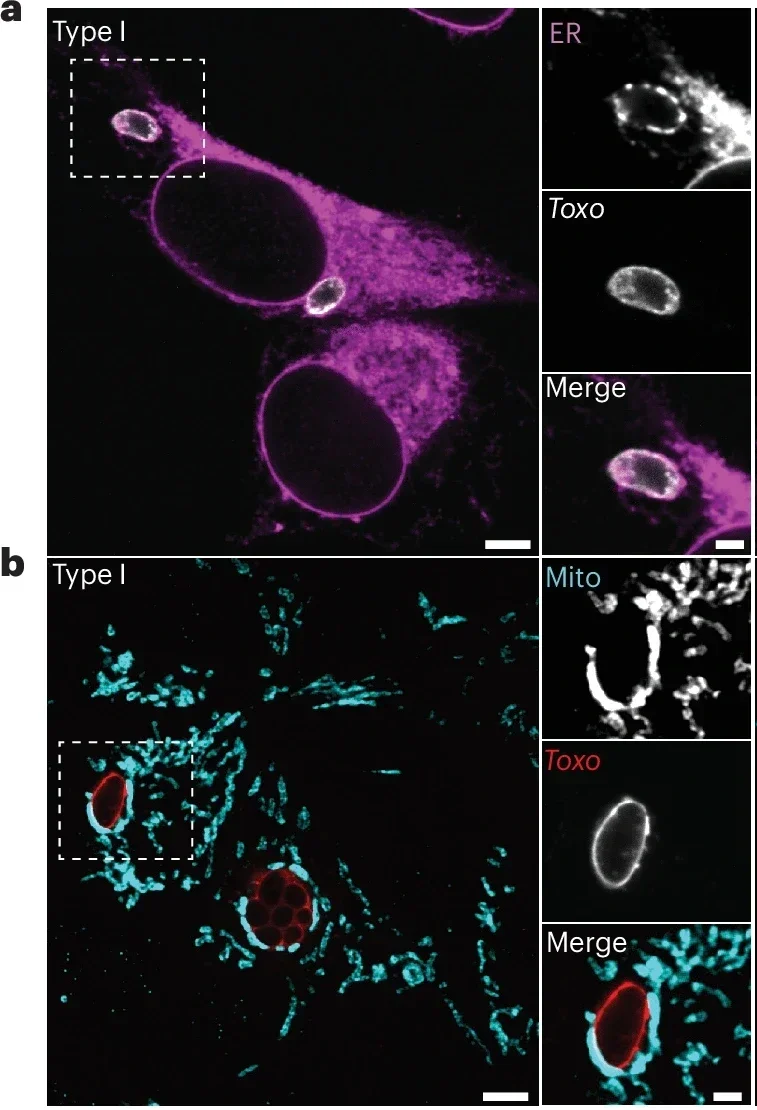
We are thrilled to announce that the amazong work of Chahat Mehra, a PhD student in the Pernas Lab, has just published in Nature Microbiology: “Toxoplasma effector TgROP1 establishes membrane contact sites with the endoplasmic reticulum during infection.”
Using a clever combination of a fluorescence-based membrane-contact reporter, CRISPR loss-of-function screening, imaging and proteomics, Chahat and her coauthors discovered that the parasite effector TgROP1 acts as a molecular tether — connecting the host endoplasmic reticulum (ER) to the intracellular vacuole that contains Toxoplasma gondii.
This ER–parasite membrane contact site (MCS) provides a novel insight into how pathogens hijack host organelle interactions, and opens new avenues to understand infection biology — and potentially design therapies targeting these contact-site tethers.
Getting published in Nature Microbiology is a major milestone and reflects the rigor, creativity, and persistence behind the work.
Please join me in congratulating Chahat for this outstanding achievement! We look forward to seeing where this work leads and celebrating many more milestones together.