We are excited to share our latest preprint from our postdoc Wilson, Temitope Ademolue, now available on bioRxiv, which uncovers a previously unrecognized form of immune regulation in mammals driven by social exposure.
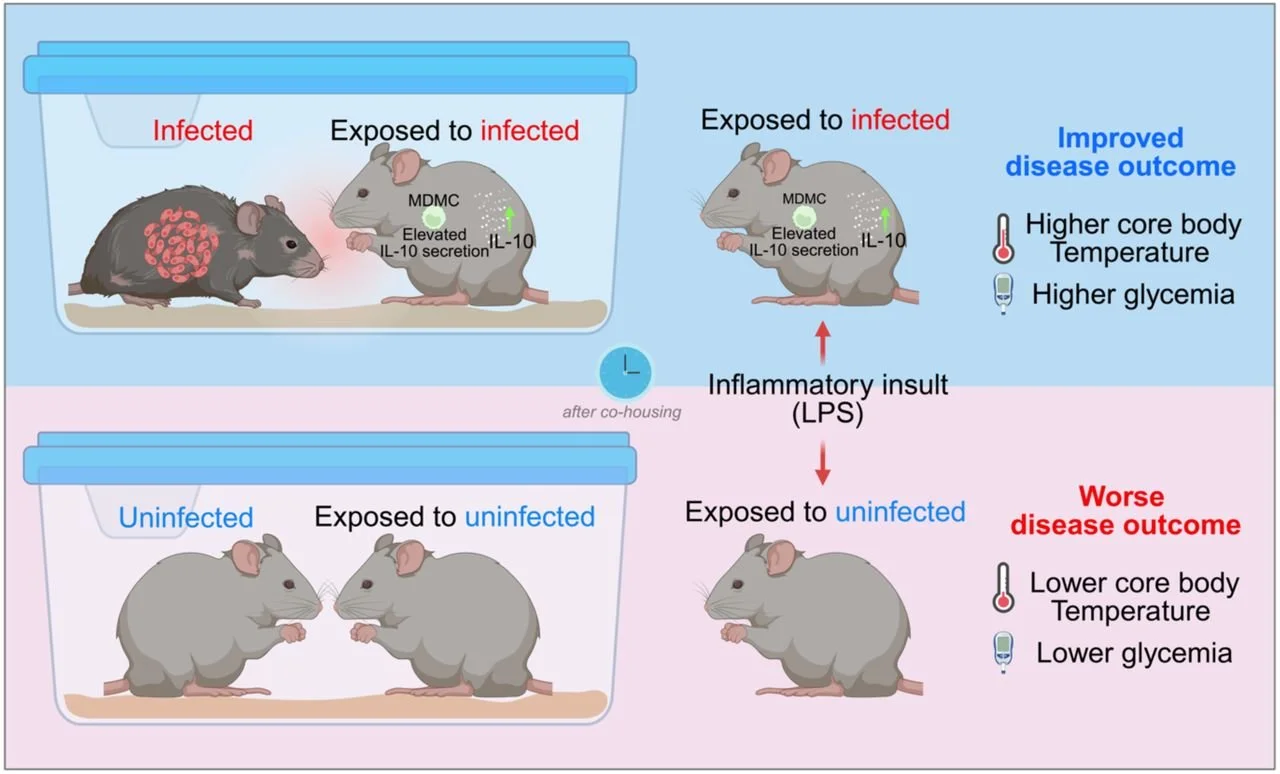
Social sensing of infection reprograms peripheral immunity in healthy mice.
In the study, Wilson and Lena asks whether mammals, like plants and insects, can mount protective immune responses based on exposure to infected neighbors. Using a mouse co-housing model, the they show that healthy mice living alongside conspecifics infected with the non-communicable parasite Toxoplasma gondii undergo a significant shift in peripheral immune responses — despite never being infected themselves!
This exposure to infected cage-mates establishes a primed immune state that enhances physiological resilience. Notably, exposed mice were better protected against a subsequent sublethal lipopolysaccharide (LPS) inflammatory challenge. Mechanistically, this protection was mediated by increased IL-10 production from myeloid cells. Blocking IL-10 signaling eliminated the exposure-induced protection, demonstrating a key role for this anti-inflammatory pathway.
Together, these findings reveal that immune responses in healthy mammals can be shaped by social exposure to infected individuals, pointing to a form of social immunity previously thought to be restricted to plants and invertebrates. This work opens new avenues for understanding how social environments influence immune homeostasis and disease resilience.
📄 Read the preprint:
https://www.biorxiv.org/content/10.64898/2026.01.28.702380v1
Please join us in congratulating Wilson on this exciting new work and in sharing this study with colleagues!